

Quality
The Swiss Army Knife of Manufacturing
June 22, 2020


September means a lot of things to different people. For some, it’s the last stretch of summer. But around the Prismier office here in Bolingbrook, Illinois, it also means arguing about the Bulls’ offseason around the water cooler.
As Bulls fans, we’ve followed the transactions. We signed Norman Powell, traded for Nic Claxton, and continue to build around Josh Giddey and Matas Buzelis.
All the roster talk got us thinking about our own business… because in a lot of ways, the modern NBA kind of mirrors the business of custom manufacturing.
Specifically, we are thinking about the most boring and unglamorous shot in basketball…

Picture a shooter standing in the corner, feet planted, completely still. He waits until the ball swings his way, then catches and shoots. That’s the whole play. Critics have a word for it: boring.
And while critics might use the word “boring,” we have some better words such as: “reliable” and “effective” and “consistent.”
That “boring” shot has quietly reshaped how the entire league is played. And it points to a truth we’ve built our whole company around: the most powerful advantages in basketball (and in business) often don’t look like advantages at all. They look like consistency.
The corner three sits 22 feet from the basket, while the above-the-break three measures 23 feet 9 inches. You’d never notice the difference from the stands, but on the scoreboard it’s the gap between a 35% shooter and a 42% shooter, compounded across hundreds of possessions.
League-wide, the effective field goal percentage on corner threes regularly exceeds 60%, making it the most efficient shot in basketball this side of a dunk.
And here’s our favorite detail: corner threes are assisted on more than 90% of attempts.
Interestingly, the edge only exists where the rulebook creates it; the NCAA, high school ball, and FIBA all use a uniform arc, with no corner shortcut. The corner three is an NBA-specific structural loophole, waiting for anyone willing to read the fine print.
Your industry has a rulebook too. Have you studied yours closely enough to know where your corners are?
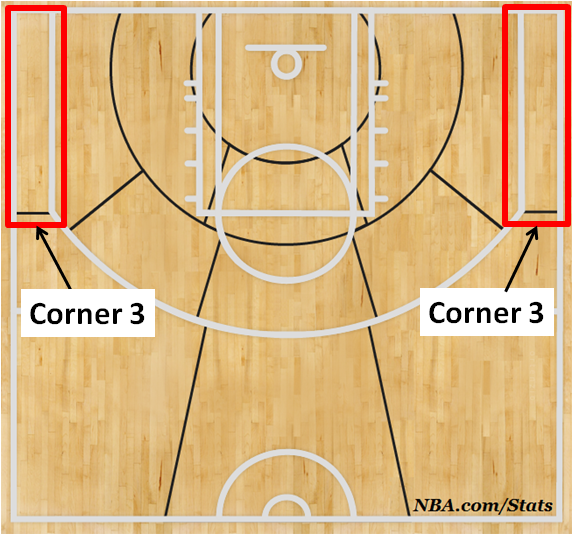
Here’s the part that should keep every operations leader up at night: the three-point line arrived in 1979, so the NBA corner has been shorter for nearly fifty years.
Yet it took until the analytics movement of the 2010s for teams to start engineering offenses around it. Why? Because the shot looked like nothing. Scouts valued creativity, coaches rewarded aggressiveness, and the guy ready to shoot in the corner was easy to overlook.
That’s one of the most important lessons in competitive strategy: we often undervalue consistency.
It’s a big part of why we liked the Powell signing: he’s coming to Chicago to knock down the efficient corner three shot, reliably.
Here’s what the box score doesn’t show, though: the best corner shooters are never actually standing still. Watch one for a full possession and he’s sprinting the baseline, relocating from corner to corner, reading the defense so that when the ball arrives, he’s already exactly where he needs to be.
The stillness at the catch is the payoff of constant motion before it.
That’s the manufacturing parallel we care about. Most companies are competing “above the break” without realizing it. They’re juggling multiple vendors, fragmented handoffs, and unpredictable lead times, with every extra handoff adding another foot of distance to the shot.
The corner three equivalent? A single, strategically positioned partner that moves the way great shooters move.
At Prismier, we’ve engineered that motion into our system. With facilities spanning the US, China, and Mexico, we can shift work between regions as your program evolves. We can optimize for cost, speed, or localization… from rapid prototype to full production. Sourcing, fabrication, finishing, assembly, packaging, and logistics all live under one roof, so when you swing the ball our way, we’re already in position, ready to perform.
Championship teams win by converting high-percentage opportunities, over and over, across a grueling 82-game season. That’s not boring. That’s discipline… and it’s what we mean when we say Manufacturing Simplified.
So as the Bulls’ roster takes shape and opening night gets closer, take a hard look at your own operation. Is your supply chain engineered around the highest-percentage shot? Or is it heaving from wherever it happens to be standing?
If you're looking for a partner who's well positioned, always ready, and consistently delivering, we'd love to show you the value Prismier can deliver.